Collecting · 6 November 2026 · 5 min read
Football card checklists and short prints
Use football card checklists to identify sets, parallels and image variations. Check SP and SSP claims without confusing card numbers with print runs.
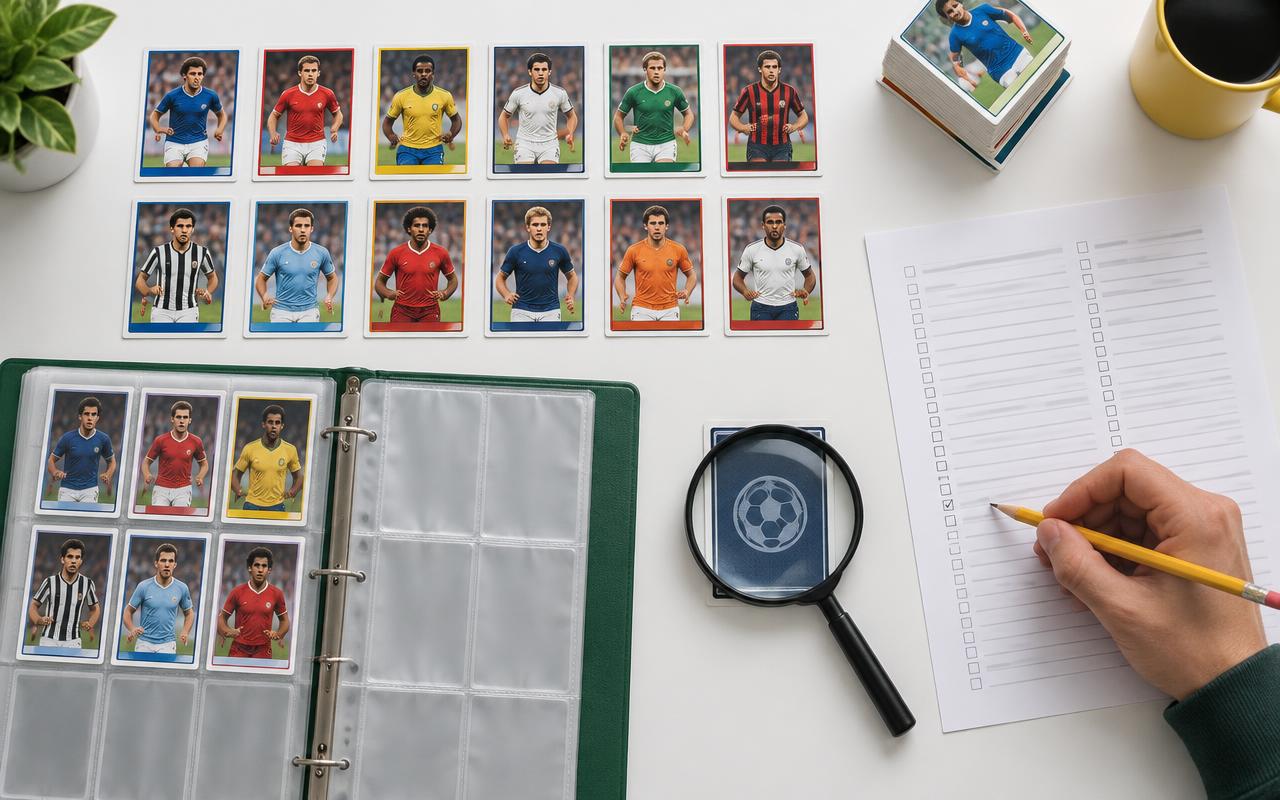
A football card checklist helps you establish what a card actually is before deciding whether it is rare, valuable or still missing from your collection. Start with the manufacturer, exact product, year or season and card number. Then work out whether you are looking at a base card, insert, parallel or image variation. SP means short print and SSP means super short print, but those labels do not give you a universal production number. A seller calling something an SSP is a claim to verify, not a reason to skip the research.
Identify the exact football-card product
Read the front and back before searching. Note the manufacturer, competition or league, product name, season or year, player and card identifier. Topps Chrome and a paper Flagship release are not interchangeable just because both feature the same player. Likewise, a World Cup product and a domestic-league set may use very different checklists. Photograph the packaging if you still have it, but remember that a loose card can be placed beside the wrong box. The card itself and the matching product information should agree. Our new-release guide explains why exact product names matter when researching a release.
Find the manufacturer's checklist first
Topps publishes an official checklist directory, and Panini provides a checklist search. Look for your exact release rather than accepting the first result with the player's name. A checklist may divide base cards, inserts, autograph subjects, relics and variations into separate sections. Search each relevant section, especially when an autograph has a letter-based identifier instead of the base card's number. Save the source and the date you checked it. If the official checklist is unavailable, an established specialist reference may help, but label the evidence accurately and do not silently present a third-party list as the manufacturer's own.
Base, inserts, parallels and variations
A base card belongs to the main set. An insert belongs to a named additional set within the product. A parallel is an alternative version with product-specific differences such as colour or finish; an image variation can use a different photograph or design detail. These categories can overlap in ways the release defines, so do not build a universal rule from one example. A shiny card is not automatically a scarce parallel, and an unfamiliar photograph does not automatically make it an image variation. Check the named section and compare the actual design. Where the product uses a specific term, preserve that wording rather than substituting a more exciting sales label.
What SP and SSP do, and do not, tell you
Short print generally describes a version produced or distributed less widely than a relevant comparison within the release. SSP signals an even shorter-print category where the manufacturer uses that term, but neither abbreviation has one fixed limit across football cards. Do not translate SP into /99 or SSP into /10 unless reliable product evidence establishes that exact number. Some cards are explicitly numbered; others are not. A manufacturer's named short-print feature can support identification without publishing its exact print run. If nobody has provided the production figure, the honest answer is that it is not established by the evidence you have.
Card numbers are not serial numbers
The number identifying a card's place in a checklist is different from a stamped serial number such as 07/25. Card #25 does not mean only 25 copies exist. A letter-based autograph code can identify the subject or insert without saying anything about the edition size. Even a serial stamp needs context: /25 may describe one particular parallel, not every card featuring that player in the product. Our serial numbers guide covers /99, /25 and 1/1 in detail. Keeping those identifiers separate prevents a simple checklist position from becoming an invented rarity claim.
Verify a suspected image variation
Compare the photograph, card number, design and relevant back details with reliable examples for that exact product. Read the manufacturer's product description alongside the checklist: some features are explained there rather than in the main base list. Do not rely on a claimed back-code shortcut unless a dependable source documents it for this release. Codes and design conventions can differ across products and years. If your card does not match a confirmed example, ask for clearer evidence rather than guessing. An unusual crop, printing issue or different regional edition may need further investigation; unfamiliarity alone does not establish an SP.
A checklist is not a price guide
Finding a player's name on an autograph checklist does not mean every box contains that autograph. A product's subject list, published odds and box-content statements answer different questions. Similarly, a checklist does not show what buyers will pay for your particular card. Use confirmed identification to search comparable completed sales, then account for condition, grade, parallel and sale date. Our football card value guide explains that process. Do not use a record sale of a 1/1 autograph to price an unnumbered base card just because both appear somewhere in the same release.
Use the checklist to build a realistic collection
A want list is useful whether you collect a full base set, one club or a single player. Record the exact card identifier and version, then mark the cards you already own. Keep expensive parallels separate from the base-set goal so the project does not quietly expand every time you see a new colour. Note duplicates for swaps, but inspect their condition before describing them to another collector. There is no obligation to complete every possible variant. A small, well-defined checklist can make collecting more enjoyable than chasing a vague idea of owning everything with your favourite player's face on it.
Your five-step identification check
First, record the exact product and card details. Second, find the matching official checklist. Third, place the card in the correct base, insert, parallel or variation section. Fourth, verify any short-print or numbering claim using release-specific evidence. Fifth, keep a note of what remains unknown before pricing, buying or selling. Ask a seller for a clear back image if the listing does not supply enough information. Walking away from an unsupported rarity claim is a reasonable result of the research, not a missed opportunity. Cover image: an illustrative collecting desk, not a reproduction of a manufacturer's checklist.
Sources and further reading
- Topps: official product checklists ↗
- Panini: official checklist search ↗
- Topps: Flagship football product information ↗
References checked on 6 November 2026. This guide is published by a football-card repack seller; it is not a manufacturer checklist or investment advice.
More collecting guides

Collecting · 3 November 2026
How to check football cards value
Find football card values using comparable sold listings, not hopeful asking prices. Check the exact set, parallel, grade, date and delivery cost.
Beginners · 29 October 2026
Football card serial numbers explained
What do /99, /25 and 1/1 mean on football cards? Learn to read serial numbers, identify parallels and compare the right cards before buying.
Releases · 28 October 2026
When are football cards released? 2026/27
Check football card releases for 2026/27: Topps Premier League, Bundesliga and UEFA products, with confirmed dates separated from calendar estimates.
New to Whatnot?
Claim your free credit.
Sign up through the link and Whatnot drops credit on your account for your first show.