Beginners · 29 October 2026 · 7 min read
Football card serial numbers explained
What do /99, /25 and 1/1 mean on football cards? Learn to read serial numbers, identify parallels and compare the right cards before buying.
You've found a football card you like, but the listing says /99, /25 or 1/1. Is that the card number? Does it mean there are only 25 cards of that player? And should a lower number always cost more? These are sensible questions, especially when the same photograph seems to appear in several listings at very different prices. This guide explains football card serial numbers without the sales pitch: how to read them, what they tell you about a particular version, and what they don't tell you about its value.
What is a serial-numbered football card?
A serial-numbered card carries a printed or stamped number identifying its copy within a stated run. You might see 17/99 on the front or back. Read it as copy 17 of a version numbered to 99. Collectors often shorten that to a card ‘out of 99’ or simply ‘/99’. Topps' hobby glossary explains the terminology, while its Dynasty product information gives a real example of football cards with very low numbering. The important word is version: the number belongs to that particular card and parallel, not every card ever made of the player.
What does /99 mean on a football card?
A card marked 17/99 is copy 17 within a stated run of 99 for that version. Another collector could own 18/99 of the same card. Both belong to that /99 run. The player may also have a regular base card, an autograph, an insert and other numbered parallels in the release. So ‘only 99 exist’ needs that context: 99 of this exact version, not 99 cards of the player across the set. The numerator identifies the copy; it does not rank its condition or make copy 17 better than copy 18.
What does /25 mean?
The same reading applies. A card stamped 08/25 is copy eight of a version numbered to 25. Leading zeros do not change the meaning. Compared with a /99 version, /25 describes a smaller stated run. That is useful when researching scarcity, but it isn't a price calculation. A /25 card of one player and a /99 card of another are not interchangeable purchases. Even for the same player, the design, subset, autograph, memorabilia and condition can change how collectors feel about the card.
What does 1/1 mean, and what is a one-of-one?
A card marked 1/1 is numbered as the sole copy of that exact version: a one-of-one. It does not mean it is the player's only card, or even their only one-of-one in that release. Another design, subset or parallel may have its own 1/1. Before buying, establish exactly what makes this version distinct. Also watch the slash: 1/25 is the first numbered copy in a run of 25, not a one-of-one. ‘First off the line’ in a seller's description is not a substitute for reading the card's actual numbering.
The checklist number is a different number
A checklist number tells you where a card belongs in a set. It may look like #97 or a code such as ADR-LM. A serial number tells you which copy of a numbered version you are looking at. One card can have both. Our Wayne Rooney Panini Nobility #97 guide covers a useful example: #97 is the base checklist entry, not a promise that only 97 copies exist. When searching for a sale comparison, keep the checklist number and the serial-number limit separate.
Serial numbering is not pack odds
A slash and a colon answer different questions. /25 describes a numbered run; a stated insertion rate such as 1:10 describes how often a card type is inserted into packs. It does not mean there are only ten copies. Pack odds also aren't a promise that your tenth pack will contain that card. Keep published insertion rates separate from numbering, and don't use /99 to calculate your chance of pulling a particular card without the release's own distribution information.
Why several printing plates can each say 1/1
Topps describes printing plates as thin metal plates used to print cards, typically in cyan, magenta, yellow and black. When included as collectibles, each colour plate may be offered as its own one-of-one. That means distinct plates for the same card design can each carry 1/1 without contradicting the numbering. A printing plate is not the same object as the finished paper or Chrome card. Identify the plate colour and card type before comparing it with another one-of-one listing.
How serial numbers relate to parallels
A parallel is a different version of a card, often distinguished by colour, finish or another design treatment. Some parallels are serial numbered; others are not. The colour alone is not enough to identify the print run, because manufacturers and sets use different systems. Our Panini Nobility parallel explanation shows a documented set-specific colour and numbering list. Use it as an example of how a checklist works, not as a universal chart for Topps or every Panini release. A gold-looking card is not automatically /10, and an unnumbered shiny card is not automatically a one-of-one.
An unnumbered card can still be a short print
Short print and serial numbered are not synonyms. A short-print designation tells you the card is less commonly produced or distributed than regular cards, but it does not by itself give you an exact total. Without a serial stamp or reliable published production information, don't assign one. Our Topps Premier League 2026/27 guide discusses the release's named short prints separately from other card types. If someone advertises an unnumbered card as ‘only 25 made’, ask where that figure comes from rather than treating a scarce-looking design as proof.
Does lower numbering always mean a higher price?
No. Numbering tells you about a stated run, not how many people want to buy the card. A favourite player, appealing design, clear autograph or attractive patch may matter more to a collector than a lower denominator. Condition matters too: a damaged /25 card is not automatically a better purchase than a clean /99. Compare completed sales for the same year, set, player, subset and parallel where possible. Keep raw cards separate from graded examples. A high asking price is an owner's hope, not evidence of a completed sale, and a low print run does not guarantee profit.
First, last and shirt-number copies
You may see sellers draw attention to 01/99, 99/99 or a copy number matching the player's shirt. These are ways to describe a particular copy within a run, not separate manufacturer print runs. If a shirt-number claim matters to you, check the relevant team and season rather than assuming a player always wore the same number. Treat any claimed premium as something to investigate through comparable sales. You don't have to pay extra for a numbering coincidence to enjoy the card, and those descriptions do not turn a /99 into a 1/1.
Read the card, not just the listing title
Ask for a sharp photograph of the number and both sides of the card. Match the year, player, checklist entry and parallel against a reliable checklist. Look for consistency between the front design, back wording and the description. A serial number alone does not authenticate a card, establish the origin of a patch or confirm an autograph's certification. If the number is hidden by a reflection or a holder label, request another photograph. If a listing says /25 but the image shows /99, stop and ask which card is actually for sale.
A real low-numbered example from Craig's hits
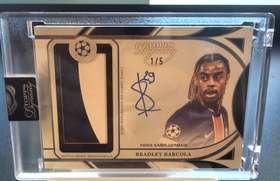
The photograph on this guide shows a Bradley Barcola Topps Dynasty autograph patch card labelled 1/5 in Craig's wall of hits. That means the first numbered copy of that particular version out of five, not a one-of-one. The photograph and existing label do not establish its season or checklist number, so we aren't assigning either here. Our Topps Dynasty collecting guide explains that numbering in the context of a premium football-card product. It is an illustration of how to read a card, not a current valuation or a promise that the same card is available.
A quick checklist before buying a numbered card
Write down the player, year, full set name, checklist number, subset and parallel. Read the complete serial stamp, including the denominator. Compare the stated version with the relevant checklist, and inspect photographs of both sides for condition. Research completed sales of genuinely comparable copies, then check delivery charges and the seller's terms before deciding your budget. Once it arrives, use a correctly sized sleeve and holder; our football-card protection guide covers the basics. Low numbering won't protect a corner from damage.
What numbering means when you're watching a repack opening
A /25 or 1/1 reveal can be exciting, but it tells you about the card that came out, not the odds of the next pack. A repack is assembled separately from the manufacturer's original sealed product. Read the current seller description and any stated guarantees rather than assuming a low-numbered hit makes every pack similar. Our football-card repack buyer's guide covers those checks. If you'd like to watch Craig open packs, see the Whatnot stream page or explore the repacks page. Collect the versions you actually want, and let the numbering help you identify them rather than choose your budget for you.
Sources and further reading
- Topps: Numbered cards explained ↗
- Topps: The collector's glossary ↗
- Topps: Printing plates explained ↗
- Topps UK hobby glossary ↗
References checked on 29 October 2026. This guide is published by a football-card repack seller; it is not a manufacturer checklist or investment advice.
More collecting guides
Set guides · 28 October 2026
Topps Premier League 2026/27 cards guide
A plain-English guide to Topps Premier League 2026/27 football cards: hobby vs value boxes, inserts, short prints, rookies and autographs.
Beginners · 28 October 2026
What does RC mean on football cards?
RC stands for rookie card. Here's what the logo tells you, why football rookie cards are harder to define than you'd think, and how to check one before buying.
Set guides · 28 October 2026
Topps Dynasty football cards: a collector’s guide to UEFA soccer releases
Understand Topps Dynasty soccer releases, low-numbered autographs and relics, and the checks that matter before buying a box or single card.
Set guides · 28 October 2026
Panini Nobility soccer cards: the 2017 set, parallels and buying checks
A practical guide to 2017 Panini Nobility football cards: base cards, short prints, autograph identification, parallel numbering and buying singles.
New to Whatnot?
Claim your free credit.
Sign up through the link and Whatnot drops credit on your account for your first show.